
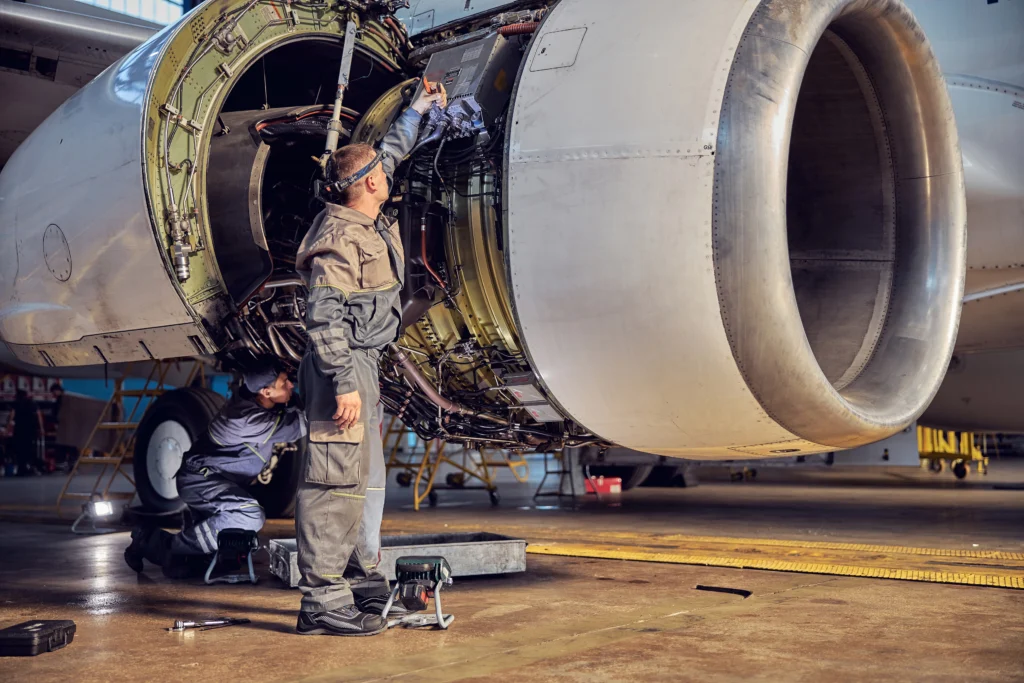
Aircraft engine maintenance costs remain under pressure even as more grounded aircraft return to service.
In August 2026, Reuters reported that spending on engine labor, repairs, and materials across six large U.S. airline operations rose approximately 68% between 2019 and 2025, while flying hours increased about 10%. Reuters noted that the underlying Department of Transportation data do not point to a single cause; engine age, cycles, shop-visit timing, fleet decisions, and other variables can all affect maintenance spending. Read Reuters’ August 2026 analysis of airline engine maintenance costs
The wider maintenance environment also remains difficult. In June 2026, IATA reported that engine durability issues, spare-parts shortages, limited spare-engine availability, and constrained aftermarket access continue to complicate airline maintenance planning. For latest-generation single-aisle engines alone, IATA expects annual shop visits to increase substantially as LEAP and GTF fleets mature. See IATA’s 2026 analysis of engine MRO bottlenecks.
Most aviation maintenance teams cannot control parts pricing, OEM repair capacity, replacement-engine availability, aircraft delivery schedules, or the size of an MRO backlog.
However, they can control the quality of the information collected before and during a maintenance decision.
That makes aircraft borescopes and remote visual inspection (RVI) increasingly important. Borescope inspections help technicians better understand internal engine condition before deciding what happens next.
When the consequences of a maintenance decision are expensive, better inspection information becomes more valuable.
When aircraft engine maintenance costs rise, maintenance teams can improve six areas within the inspection process:
These priorities don’t remove required maintenance, but they help teams make better-informed maintenance decisions.
Application note: The inspection recommendations below reflect general RVI/NDT practice and application principles. They are not engine-model-specific maintenance instructions. Applicable OEM manuals, airworthiness directives, regulatory requirements, and approved organizational procedures always govern the inspection and maintenance action.
When an abnormal indication, performance issue, or suspected internal condition requires investigation, one of the most valuable questions a maintenance team can answer is also one of the simplest:
What is actually happening inside the engine?
That information is not always easy to obtain.
Compressor components, combustion areas, turbine blades, vanes, and other internal engine surfaces may be inaccessible from the outside. Where the applicable maintenance procedure calls for or permits remote visual inspection, an aircraft borescope provides a way to examine those areas through existing access points.
The objective is not simply to “look inside”, but to collect enough useful visual information to support the next maintenance decision.
That might mean determining that another inspection or a different NDT method is required. It might also mean monitoring a condition at a defined interval, or confirming that repair, removal, or replacement is necessary.
A current FAA requirement illustrates the role condition information can play.
In July 2026, the FAA issued an Airworthiness Directive covering certain CFM LEAP-1A engines that requires initial and repetitive borescope inspections of high-pressure turbine Stage 1 blades. Depending on the inspection findings, the required next action may be another borescope inspection at a reduced interval or replacement of the affected blades. View the FAA’s 2026 LEAP-1A borescope inspection requirements
The economics in that specific directive are noteworthy as well.
For the affected product, the FAA estimated a borescope inspection at four work-hours and $340 in labor. Its estimated on-condition cost for replacing the HPT Stage 1 blade set was approximately $1 million per product. Those numbers are specific to that AD and should not be generalized to other engines, but they illustrate a larger maintenance principle: the information produced by an inspection can sit immediately upstream of a much more consequential maintenance action.
That is why inspection quality matters.
A borescope helps the technician obtain the visual evidence needed to make that decision according to the applicable criteria.
The second priority is timing. There’s a major operational difference between identifying deterioration during a planned inspection and discovering the consequences after the condition has progressed.
Depending on the engine, component, and approved inspection criteria, an aircraft engine borescope inspection may help technicians identify visible indications such as:
The 2026 FAA LEAP directive is a useful current example. The rule followed reports of in-flight shutdowns and an investigation that revealed cracks in HPT Stage 1 blades. The FAA also noted that engines operating in certain regions were susceptible to accelerated blade deterioration and airfoil distress associated with dust buildup. Its response included defined initial and repetitive borescope inspection intervals.
That illustrates a broader principle for aviation maintenance teams:
A planned inspection program should ask whether the team can clearly access, view, and document the surface that matters.
The probe has to reach the target, the camera has to face the correct surface, the lighting has to reveal usable detail, and the technician needs enough control and space to inspect the required area effectively, not just reach it.
When the aircraft maintenance manual, engine manual, airworthiness directive, or another approved procedure requires removing or opening a component, that requirement must be followed.
But additional disassembly should not be necessary solely because the maintenance team lacks an effective way to see an internal area when an approved RVI procedure provides the necessary access.
That distinction is important.
Opening an assembly can introduce additional labor and process steps: obtaining access, removing components, protecting removed hardware, reassembly, required checks, documentation, and potentially additional aircraft or component downtime.
Remote visual inspection can first provide useful condition information and answer a practical question: “Can the approved borescope inspection give us enough information to determine whether taking this apart is necessary?”
The FAA’s current LEAP requirement illustrates the concept. Borescope inspection findings are used to determine whether continued repetitive inspection or blade replacement is required.
The inspection therefore functions as a decision point:
If the finding requires escalation, the maintenance team escalates. But if the applicable criteria call for another inspection later, the team has avoided taking a more extensive action before the evidence required it.
RVI is a way of obtaining necessary information before choosing the next maintenance action.
A borescope inspection should ideally produce more than a technician’s memory of what was seen. Images and video create a visual record of engine condition at a defined point in time
Suppose one technician identifies an area of surface deterioration today. At a later inspection, another technician sees a similar condition.
Without consistent inspection records, several questions can become difficult to answer:
When inspections repeat, a consistent visual record provides valuable context.
Practical RVI recommendation: Where organizational procedures support it, maintenance teams can increase the usefulness of borescope records by standardizing information such as:
The value comes form creating a clearer visual history, and instead of asking simply:
“What are we seeing today?”, the maintenance team can ask: “How does what we’re seeing today compare with what we documented previously?”
That’s especially valuable for organizations conducting recurring aircraft engine borescope inspections across different technicians, aircraft, engines, or facilities.
Good documentation turns individual inspections into a more useful stream of condition information.
A planned engine inspection already consumes resources.
The aircraft or engine has to be available, a technician has to perform the work, access has to be established, the inspection procedure has to be completed and documented.
Once that time is committed, the objective should be to obtain the best usable information the approved inspection allows.
This is where equipment selection and inspection planning intersect.
A successful aircraft borescope inspection can depend on:
Consider an inspection where the target sits perpendicular to the insertion path. A probe may physically reach the location but still provide a poor view if the camera is looking straight ahead.
In another inspection, the challenge may be navigating a tight internal path. In another, the primary issue may be illumination.
This is why choosing an aviation borescope based on resolution alone is incomplete.
The access point sets an immediate upper limit on probe diameter.
Measure the inspection path, not simply the outside dimensions of the component.
Internal geometry can change the amount of flexibility and articulation required.
If the target sits to the side of the insertion path, a side-view or dual-view configuration may be more useful than straight viewing alone.
Access without control can still result in poor inspection coverage.
Deep cavities, reflective surfaces, small probes, and inspection distance can all affect usable visibility.
If technicians need images or video for records or comparison, documentation capabilities should be evaluated before purchasing the system.
This is also where borescope versatility starts affecting equipment ROI.
SPI’s Recon Pro platform is built around an interchangeable-probe system rather than forcing one probe configuration to fit every application. The current platform supports forward-view probe diameters from 1.0 mm through 8.4 mm, with different articulation and viewing configurations available depending on probe size.
That design matters when a maintenance organization has more than one inspection requirement.
The better question becomes: “Which probe does this inspection require?” rather than: “Which complete borescope do we have to purchase next?”
The final controllable priority is the purchasing decision itself.
Maintenance teams understandably care about acquisition price. But the lowest-priced borescope is not necessarily the lowest-cost inspection solution.
If the probe cannot reach the target after the access poin effectively, articulate toward the required surface, provide sufficient illumination, or produce a useful image, its purchase price becomes largely irrelevant.
A better selection sequence is:
Access → Reach → Geometry → Viewing Angle → Articulation → Lighting → Documentation → Durability/Service → Cost
Start with the smallest opening the probe must navigate.
Use the 50-60% rule; the probe diameter to roughly 50–60% of the inspection opening when the application allows. For extremely restricted access, SPI offers ultra-thin probe options starting at 1.0 mm. All SPI probes are compatible with a single base unit through our interchangeable probe system. See SPI’s ultra-thin borescope probe options.
Not every aircraft engine inspection target sits directly in front of the camera.
SPI offers side-view and dual-view probe configurations for applications where technicians need to examine surfaces at different angles. For example, the 3.9 mm Recon Pro probe is available in straight-view, side-view, and dual-view configurations with four-way articulation. Explore the 3.9 mm Recon Pro borescope probe
A maintenance organization may need a smaller probe for one engine access point and a larger, more robust probe for another inspection.
That is where an interchangeable platform can materially change the buying equation.
Instead of duplicating the display, control unit, battery, and other system hardware every time another probe configuration is needed, the Recon Pro and the next-generation platform Recon: Gen. 2 allow compatible probe assemblies to be changed on the same base unit. Swapping between probes mid-inspection also becomes substantially more efficient; our system makes it easy to switch between probes within one minute.
Total cost of ownership also includes what happens after purchase. Inspection equipment lives in a demanding environment. Probe assemblies can eventually become damaged or require service.
SPI’s approach includes a probe swap and repair program designed to help our customers restore inspection capability without automatically replacing the complete system.
That supports a broader purchasing principle:
Evaluate the borescope as an inspection platform, not merely as a camera.
The optimal system fits the access requirements, supports the applications the team performs, produces useful, high-quality visual evidence, and remains practical to own over time.
Aviation maintenance teams cannot solve the engine MRO shortage themselves.
IATA’s June 2026 analysis identifies durability challenges, parts availability, spare-engine shortages, aftermarket constraints, and rising shop-visit demand as industry-level problems.
And Reuters’ August 2026 reporting shows why the financial consequences remain significant even as engine availability improves.
The maintenance team has a different opportunity; it can improve the quality of the information entering the maintenance decision.
The 6 steps in this article don’t promise to eliminate engine maintenance costs. The objective is to help maintenance teams make better-informed decisions in an environment where poor information can become increasingly expensive.
And that’s what makes the quality, flexibility, and usability of inspection equipment more important.
Engine maintenance costs are being influenced by forces aviation maintenance teams cannot easily change: parts availability, shop capacity, engine durability, supply-chain constraints, and replacement-engine availability.
But maintenance teams can improve the quality of the inspection information behind their decisions. That means:
SPI Borescopes is built around those controllable variables.
The Recon Pro and Recon: Gen.2 platforms combine high-resolution imaging with interchangeable probe options across multiple diameters and inspection configurations, allowing aviation teams to adapt the inspection tool to the application instead of forcing every application through one fixed probe.
Just as importantly, at SPI we don’t expect a maintenance team to determine equipment fit from a specification sheet alone:
The free SPI mail-out demo program allows teams to test a configured borescope on their own components, with their own technicians, through their actual access points, evaluating probe fit, articulation, lighting, maneuverability, and image quality before making a purchasing decision.
When aircraft engine maintenance is expensive, optimize the inspection first, then choose the borescope that can actually perform it effectively.
Related Articles

A recent EASA survey found that aviation professionals are cautiously optimistic about AI in aviation safety, rating acceptance at 4.4 out of 7. Key concerns include performance limits, privacy, accountability, and the risk of de-skilling.

This is a defining period for the oil and gas industry, with the pressures of ultimately shifting to sustainable energy sources already being felt, and the competitive market striving for greater efficiency constantly.

The aerospace industry is poised for unprecedented growth, with the global market for aerospace parts manufacturing projected to soar to USD 1.29 trillion by 2031.
Join Our Newsletter
